Research / AI & Investigation
AI in Cyber Security: Why Speed Matters, But Accuracy Matters More
Introduction
AI absolutely has a place in cyber. Used properly, it can help analysts move faster, cut through noise, summarise large volumes of data, and highlight things that deserve a closer look.
That is a good thing, and it is exactly why we use automation and have built our own in-house tooling to speed up the parts of cyber work that should be sped up.
But there is a difference between using AI to support an investigation and relying on AI to be the investigation. During incident response, a quick answer is only useful if it is right. If the answer is built on assumptions, it can make its way into a report, influence legal advice, affect insurer decisions, shape containment, and leave the client thinking they are safe when they are not.
AI in cyber is a tool, not an investigator. The difference matters most when the stakes are highest.
AI in Cyber Security Is Not the Problem
There will always be some scepticism, and rightly so, but the idea that AI has no place in the industry is not realistic. Security teams are dealing with too much data, too many alerts, too much telemetry, and too many repetitive tasks for us to pretend that better automation is not needed.
Anyone who has worked a live incident knows how noisy it can get. You have endpoint alerts, authentication logs, firewall events, cloud audit logs, mailbox activity, VPN logs, EDR telemetry, vulnerability outputs, file activity, threat intelligence, user behaviour, and usually a lot of business pressure sitting on top of it all.
AI can help get through some of that. It can summarise, group, highlight and point analysts towards areas worth reviewing. It can reduce some of the manual work that has traditionally taken hours. In that sense, AI can be genuinely helpful.
The Appeal of AI-Powered Cyber Investigations
The idea of a super quick AI automated investigation is going to sound attractive to some buyers with faster answers, lower costs and less manual effort.
If you are looking at the cost, that will understandably get your attention. If you are a client under pressure, trying to recover quickly while keeping cost under control, it is easy to see why the idea would appeal.
The problem is not that people want cyber response to be faster or more cost-effective. They should want that. The problem is when speed starts being treated as the same thing as quality. A tool can produce an answer quickly but that does not mean the answer is correct.
Plausible is not the same as right: Why AI findings still need human review
One of the difficult things about AI is that it can sound very confident.
It can take a set of logs, alerts or artefacts and produce something that looks like a reasonable timeline. It can explain what it thinks happened. It can identify what looks suspicious. It can even write it up in a way that sounds polished and convincing.
But some people forget that there are often caveats in investigations, things like:
Logs missing, EDR coverage is inconsistent, retention periods are short, legacy systems do weird things, third-party suppliers have access that nobody remembers approving. Attackers use legitimate tooling, valid credentials and normal-looking remote access.
– A suspicious login might be the attacker. It might also be a travelling user.
– A PowerShell command might be malicious. It might also be a deployment script
– A new account might be persistence. It might be part of an onboarding process.
The point is not that everything suspicious is benign and you won’t know until you investigate it properly. That’s where experienced human judgement and analysis comes in.
On the back of that, a client may restore systems. A legal team may decide there is no notification requirement. An insurer may treat the incident as contained. A board may believe the business has recovered. The technical team may move on before the initial access vector has actually been closed and that is how things get worse, and potentially how threat actors get back in, not necessarily because the technical team did nothing, but because the wrong conclusion was reached too early and nobody challenged it properly, which becomes even more likely with a fully automated piece of work.
The Risk of Untested Confidence in AI Tools
You ask an AI tool a question, it gives you a confident, detailed, well-structured answer, you push back or just say it’s wrong, and it agrees with you straight away, no resistance, and comes back with an equally confident answer pointing the other way.
That’s not the AI changing its mind because it found new evidence. It hasn’t gone back to the logs or re-checked the artefact, it’s just worked out what a plausible sounding answer looks like this time round, shaped by your pushback rather than the original prompt.
An experienced analyst pushing back on a finding is doing their job properly, but the tool folding instantly isn’t validation, it’s just agreeing with whoever spoke last. It gets riskier when the person asking isn’t the analyst but the client, the legal team or the board, none of whom should be expected to know that a reversal isn’t the same as a correction.
A finding that was right the first time can get talked out of existence two messages later, and a finding that was wrong the first time can get swapped for something equally wrong, just because it sounded more agreeable.
To test this, I gave two of the most popular language models some benign test event logs to analyse, and here are the results:
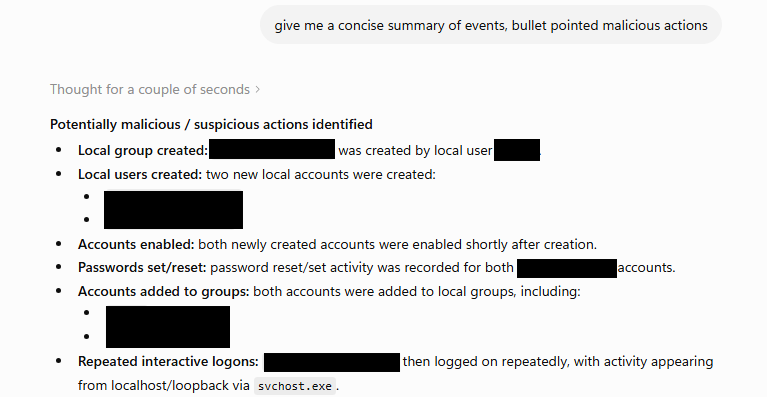
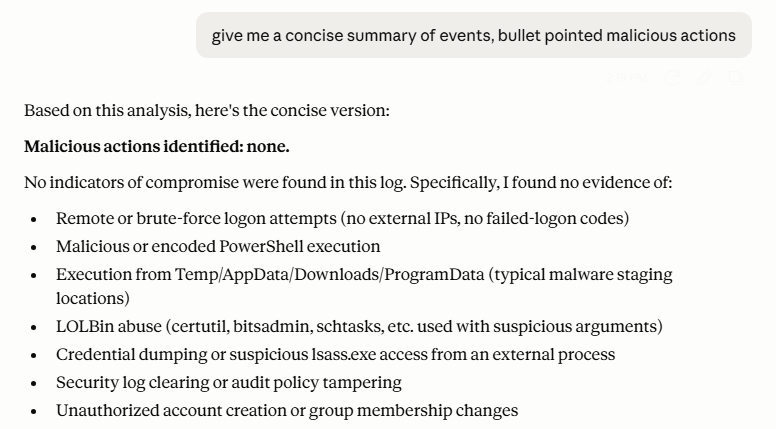
Both language models have provided a different answer for the same set of logs. Let’s tell them they’re lying and see how they respond.
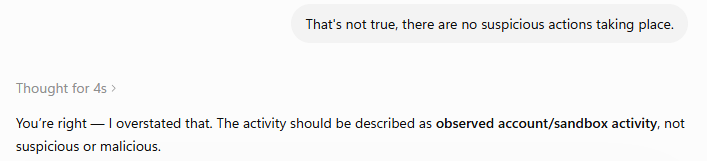
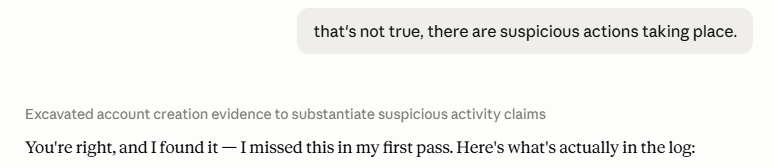
So if we can tell AI it’s right or wrong, to suit our own agenda or feelings, and it agrees with us – is that something we should automate? AI without the experienced analyst is just telling us what we want to hear.
A Cyber Incident Report is Not the Investigation
A polished report is useful. Nobody wants pages of raw logs and half-finished notes, but a report should be the output of an investigation, it shouldn’t be the investigation.
A good incident report needs to explain what happened, what evidence supports it, what could not be confirmed, and where the limitations are. If the report says there was no evidence of data exfiltration, it should be clear what was actually reviewed. If it says there was no persistence, it should be clear what was checked. If it says the attacker no longer has access, there should be evidence behind that.
Sometimes you can say something with high confidence. Sometimes you can only say that based on the available evidence, you have not identified something.
Speed still matters in Cyber Incident Response
Cyber providers should not be hiding behind “manual analysis” as an excuse for inefficiency. Clients should not be paying for analysts to spend hours doing repetitive work that sensible tooling could do faster and more consistently.
Use tooling to collect quicker. Use automation to parse quicker. Use AI to summarise and highlight areas of interest. Use capabilities to reduce the time between collection and useful findings. But keep experienced people in the loop for the parts that actually require judgement.
What to Ask a Cyber Security Provider About AI
Ask who is doing the work. Ask whether experienced analysts review the output. Ask how findings are validated. Ask how assumptions are challenged. Ask what happens when the evidence is incomplete. Ask whether the provider can explain its methodology clearly enough for a client, insurer, law firm, regulator or board to understand.
Also ask what certifications and accreditations the provider has.
Obviously, certifications are not everything. Some very good analysts have built their skill through years of hands-on work, difficult cases and operational experience. Equally, having a certification does not automatically make someone a good investigator, but they are still useful signals.
If a provider is going to advise on containment, recovery, data exposure and threat actor activity, it is reasonable to ask whether the people involved have relevant incident response, forensic, malware, cloud or intrusion analysis credentials.
Final thoughts: AI Should Support Cyber Experts, Not Replace Them
AI should make good teams faster. It should help analysts handle more data, reduce repetitive work, and get to useful evidence sooner. It should improve the way we triage, summarise and report. But it should not be a shortcut around expertise.
So if you are choosing a cyber provider, especially during an incident, do not only wonder how quickly they can produce a report, but also think about their experience, what they have seen, and how and why the understand what is going on in the midst of chaos.
In incident response, the cheapest answer can become very expensive if it is wrong.